11 African countries · Alliance for a Green Revolution in Africa (AGRA) · November 2020 to June 2021
Stakeholder engagement and mapping in eleven countries for AGRA.
Stakeholder engagement and mapping across eleven African countries for the Agricultural Resilience Strategy of the Alliance for a Green Revolution in Africa, November 2020 to June 2021.
Formal title: 11-Country Stakeholders Engagement and Mapping for the Agricultural Resilience Strategy of the Alliance for Green Revolution in Africa (AGRA)
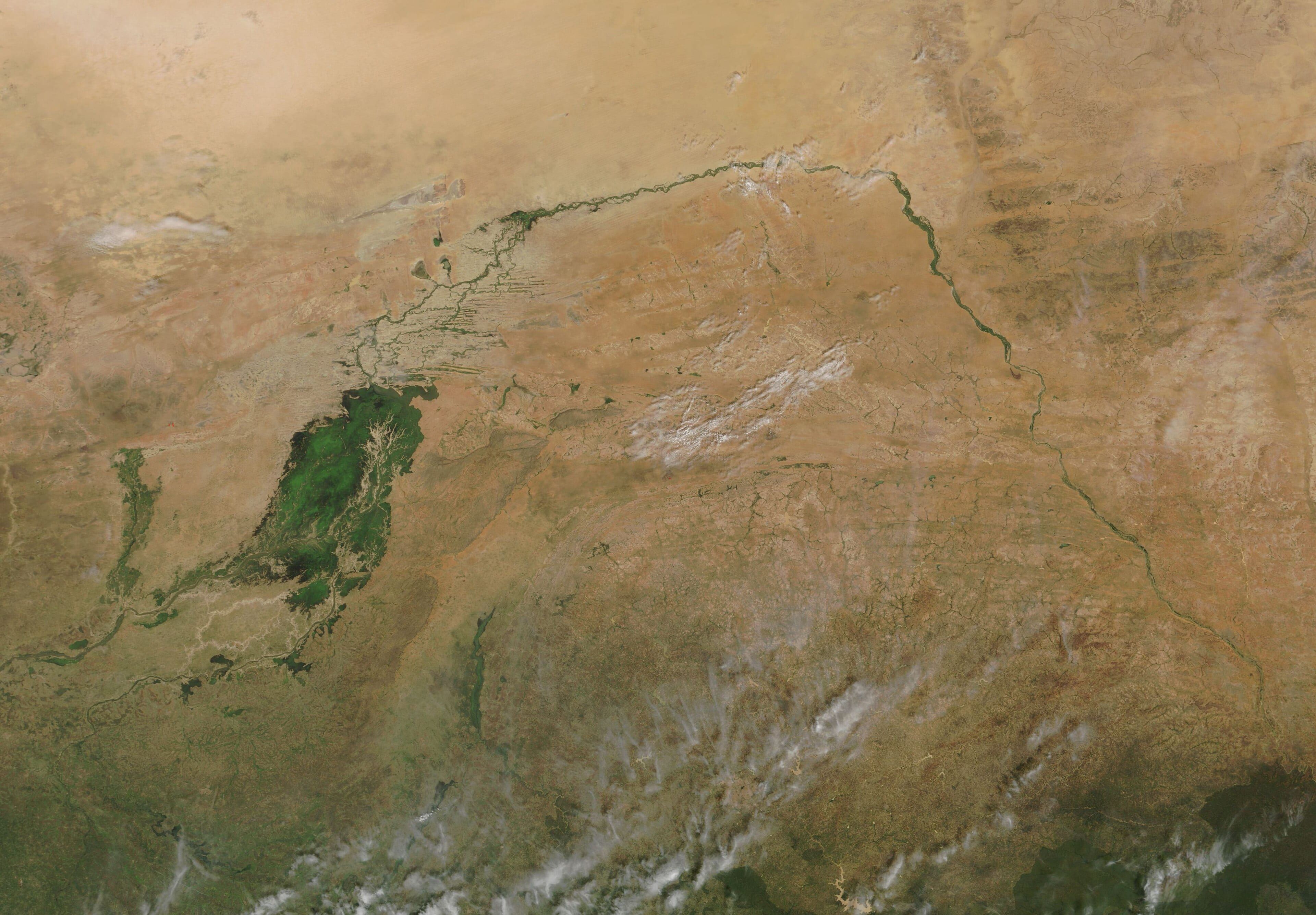
Satellite view: The Niger River and its inland delta, MODIS, Mali. Image: MODIS Land Rapid Response Team, NASA GSFC, Public domain, via Wikimedia Commons. Shown for the landscape, not as a record of the project.
The brief
A resilience strategy for African agriculture depends on the people who will carry it out. AGRA's Agricultural Resilience Strategy needed a map of the stakeholders in eleven countries and a programme of engagement with them. AGDF delivered both between November 2020 and June 2021.
Why it matters to AGDF
The engagement is recorded in AGDF's experience under two headings at once: participatory learning approaches, and collaboration and market linkages. It is the widest geographic engagement in the Forum's record.
How the team contributed
Mrs Eyeoyibo was technical lead for the eleven-country engagement and mapping. Her profile also records her earlier work on agricultural resilience: contributing authorship of Nigeria's National Agricultural Resilience Framework and consultancies on climate-smart agriculture value chains in West Africa.
Related
 ImpressionStudy
Nigeria · African Development Bank (AfDB & Dutch RVO)
Nigeria's transition to a green economy.
A detailed evaluation of the current landscape for transitioning Nigeria from an unsustainable linear economic model to a circular model along critical sectors, and of the public-private partnership investments that link circularity to natural capital.
Read the case ImpressionFramework
Nigeria · African Development Bank (AfDB & Dutch RVO)
A roadmap framework for a circular Nigeria by 2050.
Built on a Theory of Change, the framework sets out the strategies and activities to be carried out towards transitioning Nigeria to a circular economy in 2050, accompanied by an MRV policy brief and a policy brief.
Read the case ImpressionStudy
Rwanda · Analysis period 1960 to 2030
Methane from Rwanda's solid waste disposal sites, 1960 to 2030.
A Tier 2 estimate of methane emissions from solid waste disposal sites in Rwanda from 1960 to 2030, using the IPCC First Order Decay model, as a component of carbon accounting for the waste sector.
Read the case