
Nigeria · AfDB & Dutch RVO
Nigeria's transition to a green economy.
A detailed evaluation of the current landscape for transitioning Nigeria from an unsustainable linear economic model to a circular model along critical sectors, and of the public-private partnership investments that link circularity to natural capital.
Formal title: Nigeria's Transition to Green Economy: Linking Circular Economy and Natural Capital for Public Private Partnership (PPP) Investments
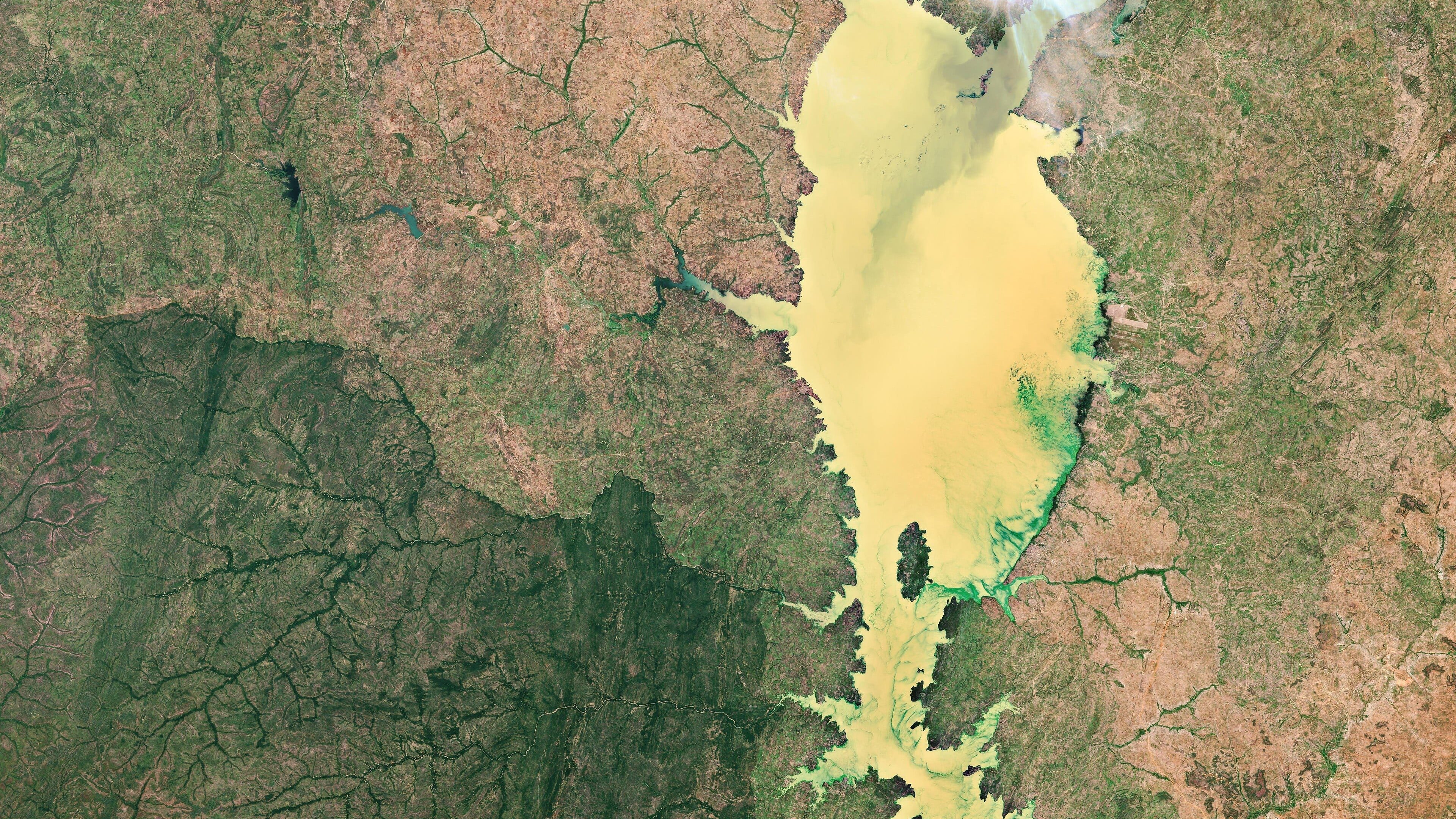
Satellite view: Kainji Lake on the Niger River, Copernicus Sentinel-2, Niger and Kebbi States, Nigeria. Image: ESA, contains modified Copernicus Sentinel data (2020), Copernicus Sentinel data terms, free use with attribution, via Wikimedia Commons. Shown for the landscape, not as a record of the project.
The brief
The African Development Bank, with the Netherlands Enterprise Agency (RVO), asked AGDF to evaluate in detail where Nigeria's economy stands on the path from a linear model, in which resources are extracted, used and discarded, to a circular one, and to link that transition to the natural capital it depends on and to the public-private partnership investments that could finance it.
Scope
The evaluation was organised around four priority sectors and their focal industries:
- Energy: power, oil and gas, and transport and logistics.
- Agriculture, Forestry and Other Land Uses (AFOLU): agro-allied products and forestry.
- Industrial Processes and Product Use (IPPU): construction and textiles.
- Services sector, inclusive of waste and water sub-components: packaging, electronics and organic waste industries.
How the team contributed
The profiles of the AGDF experts record their parts in this body of work: Prof. Andrew-Essien coordinated the teams on agriculture, forest and land use in the circular economy work for the AfDB, RVO and GGKP; Ekaba Bisong helped set the circular economy and natural capital agenda with the same partners, with a focus on green growth, donor and bank support and PPP investment; Mrs Eyeoyibo consulted on the Circular Economy Scoping Report for Nigeria; and Prof. Bisong brought his experience as an independent expert on circular economy for UNEP and the AfDB.
The study is the foundation for the Nigerian Circular Economy Programme outputs listed below.
Outputs
Related
 ImpressionFramework
Nigeria · African Development Bank (AfDB & Dutch RVO)
A roadmap framework for a circular Nigeria by 2050.
Built on a Theory of Change, the framework sets out the strategies and activities to be carried out towards transitioning Nigeria to a circular economy in 2050, accompanied by an MRV policy brief and a policy brief.
Read the case ImpressionStudy
Rwanda · Analysis period 1960 to 2030
Methane from Rwanda's solid waste disposal sites, 1960 to 2030.
A Tier 2 estimate of methane emissions from solid waste disposal sites in Rwanda from 1960 to 2030, using the IPCC First Order Decay model, as a component of carbon accounting for the waste sector.
Read the case ImpressionReport
Nigeria · African Development Bank (AfDB) · December 2020 to March 2021
Waste and circular economy analysis for Nigeria's enhanced NDC.
Analysis of greenhouse gas emissions from waste management in Nigeria and of the circular economy's impact on them, for the enhancement of the country's Nationally Determined Contribution for 2021 to 2025.
Read the case