Nigeria · Building Nigeria's Readiness for Climate Change (BNRCC)
Fish farming and fuel-efficient woodstoves as alternative livelihoods.
Local fishing communities trained in fish farming from pond construction to management of a stocked pond, and households empowered with fuel-efficient woodstoves to reduce deforestation.
Formal title: Building Nigeria's Readiness for Climate Change (BNRCC)
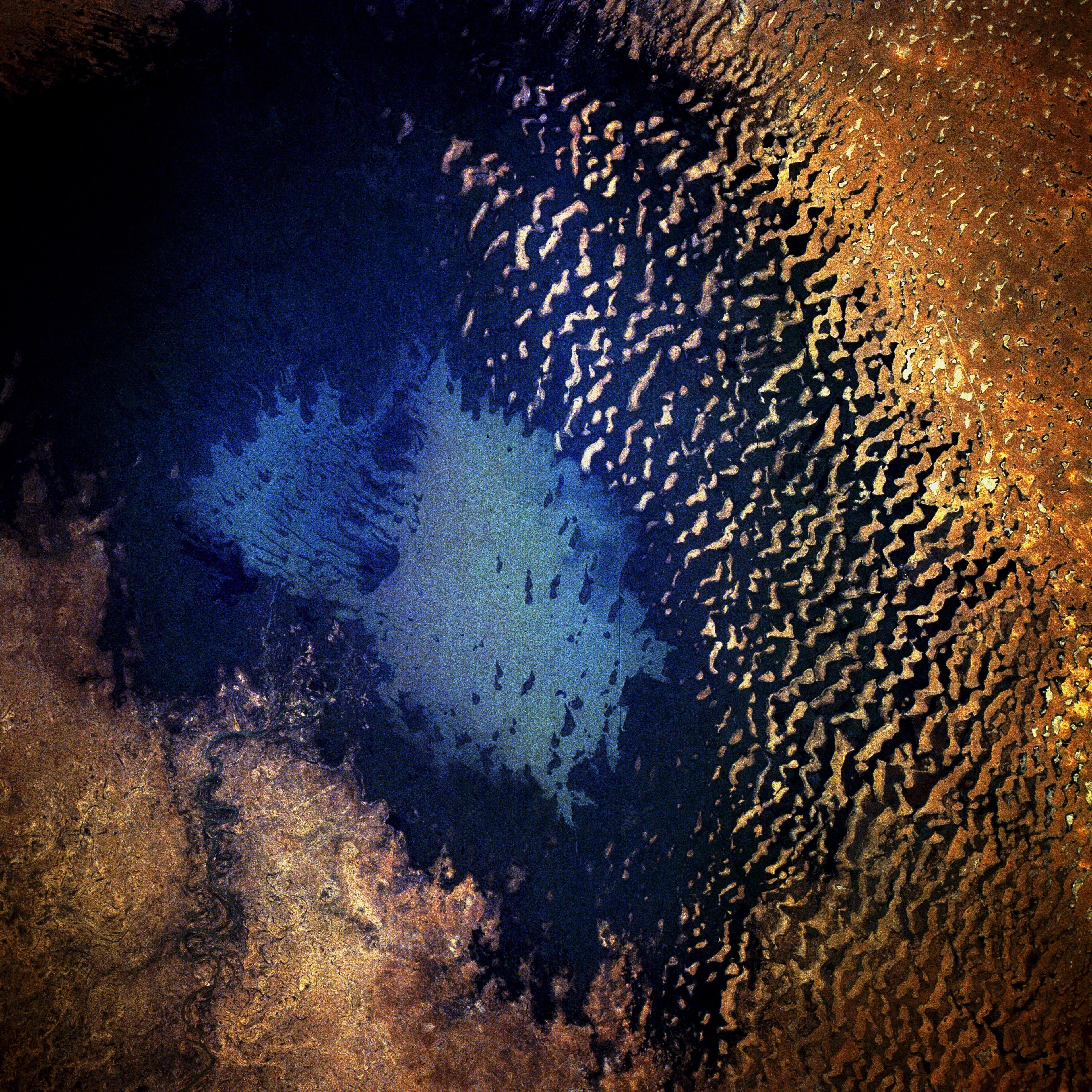
Satellite view: Lake Chad from the Space Shuttle, STS-61, Chad, Cameroon, Nigeria and Niger. Image: NASA, STS-61 crew, Public domain, via Wikimedia Commons. Shown for the landscape, not as a record of the project.
Adaptation through livelihoods
AGDF's approach to environmental problems works through the livelihood options of local communities. Under Building Nigeria's Readiness for Climate Change, that approach took two practical forms.
- Local fishing communities were trained in fish farming, from pond construction to the management of a stocked pond, as an alternative livelihood, and were empowered with a community fish pond.
- Households were trained and empowered with fuel-efficient woodstoves to reduce deforestation.
Both are recorded in AGDF's experience as technical assistance and capacity development within a project.
Related
 ImpressionStudy
Nigeria · African Development Bank (AfDB & Dutch RVO)
Nigeria's transition to a green economy.
A detailed evaluation of the current landscape for transitioning Nigeria from an unsustainable linear economic model to a circular model along critical sectors, and of the public-private partnership investments that link circularity to natural capital.
Read the case ImpressionFramework
Nigeria · African Development Bank (AfDB & Dutch RVO)
A roadmap framework for a circular Nigeria by 2050.
Built on a Theory of Change, the framework sets out the strategies and activities to be carried out towards transitioning Nigeria to a circular economy in 2050, accompanied by an MRV policy brief and a policy brief.
Read the case ImpressionStudy
Rwanda · Analysis period 1960 to 2030
Methane from Rwanda's solid waste disposal sites, 1960 to 2030.
A Tier 2 estimate of methane emissions from solid waste disposal sites in Rwanda from 1960 to 2030, using the IPCC First Order Decay model, as a component of carbon accounting for the waste sector.
Read the case